


When you search for cooling sheets in July, most of the content focuses on cold touch — the initial chill when you first slide into bed. That sensation is real and measurable. But for people sleeping in humid climates, it misses the actual problem.
In a humid environment, the issue isn't just surface temperature. It's moisture: accumulated sweat and ambient humidity that turns sheets damp, raises perceived temperature, and disrupts sleep throughout the night. For hot sleepers in the South, Mid-Atlantic, or any region where summer humidity regularly exceeds 60 to 70%, cold touch alone isn't enough. Moisture management is the spec that actually determines whether you sleep through the night.
The Difference Between Cold Touch and Moisture Management
These are two separate fabric properties solving different parts of the same problem.
Cold touch (Qmax) measures how quickly a fabric draws heat away from the skin on first contact. A higher Qmax means a cooler initial sensation. Breescape's BlendTek™ fiber has a Qmax of 0.46 — 4.5x greater breathability than cotton and 3.1x cooler on first contact than bamboo rayon.[1]
Moisture management describes what happens over the following 6 to 8 hours. Can the fabric absorb sweat quickly? Does it release that moisture, or trap it? A fabric that absorbs moisture but cannot release it eventually becomes a heat sink — your body's sweat stays close to the skin, adds humidity to the space between you and the sheet, and makes you progressively warmer through the night.
Property |
What It Measures |
Why It Matters in Humid Climates |
Qmax (cold touch) |
Initial heat absorption from skin |
First impression; less critical for sustained comfort |
Moisture absorption |
Volume of sweat fabric can take in |
Manages active sweating during sleep |
Moisture-wicking speed |
How fast sweat moves away from skin |
Prevents pooling and damp sensation |
Breathability |
Airflow through the fabric structure |
Allows absorbed moisture to evaporate |
Drying speed |
How fast fabric dries after wetting |
Prevents the wet-sheet feeling by morning |
In a humid climate, you need solid performance across all five. A fabric that excels only at cold touch will feel cool for the first 20 minutes and progressively warmer as body heat and ambient humidity accumulate.
What Happens to Your Body in a Humid Bedroom
Your body cools itself during sleep primarily through evaporation: sweat on the skin evaporates and carries heat away.[2] In dry air, this works efficiently. In high humidity, the atmosphere is already saturated with moisture, which limits further evaporation — so sweat stays on the skin longer and provides less cooling benefit.
In practical terms:
- When relative humidity exceeds 60%, sweat evaporation is noticeably impaired
- At 70% or above, the body's ability to self-regulate through perspiration drops significantly[3]
- Core body temperature typically needs to drop 1 to 2 degrees F from its daytime peak to initiate and sustain deep sleep — high ambient humidity makes this harder[4]
This is why people in Miami, Houston, and coastal New York often report worse summer sleep than people in Phoenix, even though Phoenix is hotter in absolute temperature terms. Dry heat is manageable through normal thermoregulation. Humid heat isn't. Your bedding either helps that process or gets in the way.
How BlendTek™ Fiber Is Structured for Humid Conditions
Breescape's BlendTek™ fiber uses a polygonal cross-section — a geometric design that creates more exposed surface area per fiber than round fibers in standard fabrics.[1] This produces two direct functional effects:
- Greater moisture absorption. More fiber surface means more contact points where sweat can be absorbed before it pools on the skin.
- Active moisture release. The same open gaps in the polygonal structure that absorb moisture also allow airflow through the fabric — meaning absorbed moisture can evaporate faster, even when ambient humidity is already high.
The result: BlendTek™ delivers 1.5x higher moisture absorption than cotton[1], wicks that moisture away from skin contact rather than letting it sit, and uses its breathable structure to promote heat dissipation throughout the night. For humid-summer sleepers, these last two properties matter more than Qmax alone.

Why Thread Count Is the Wrong Metric Here
Thread count is still the most commonly used buying signal for sheets, and for humid-climate sleeping it's actively misleading. A higher thread count means more threads packed per inch — which reduces the space between fibers and cuts airflow. For a hot, humid summer night, a 400-thread-count cotton sateen consistently traps more heat than a well-engineered cooling fiber at a lower thread density.
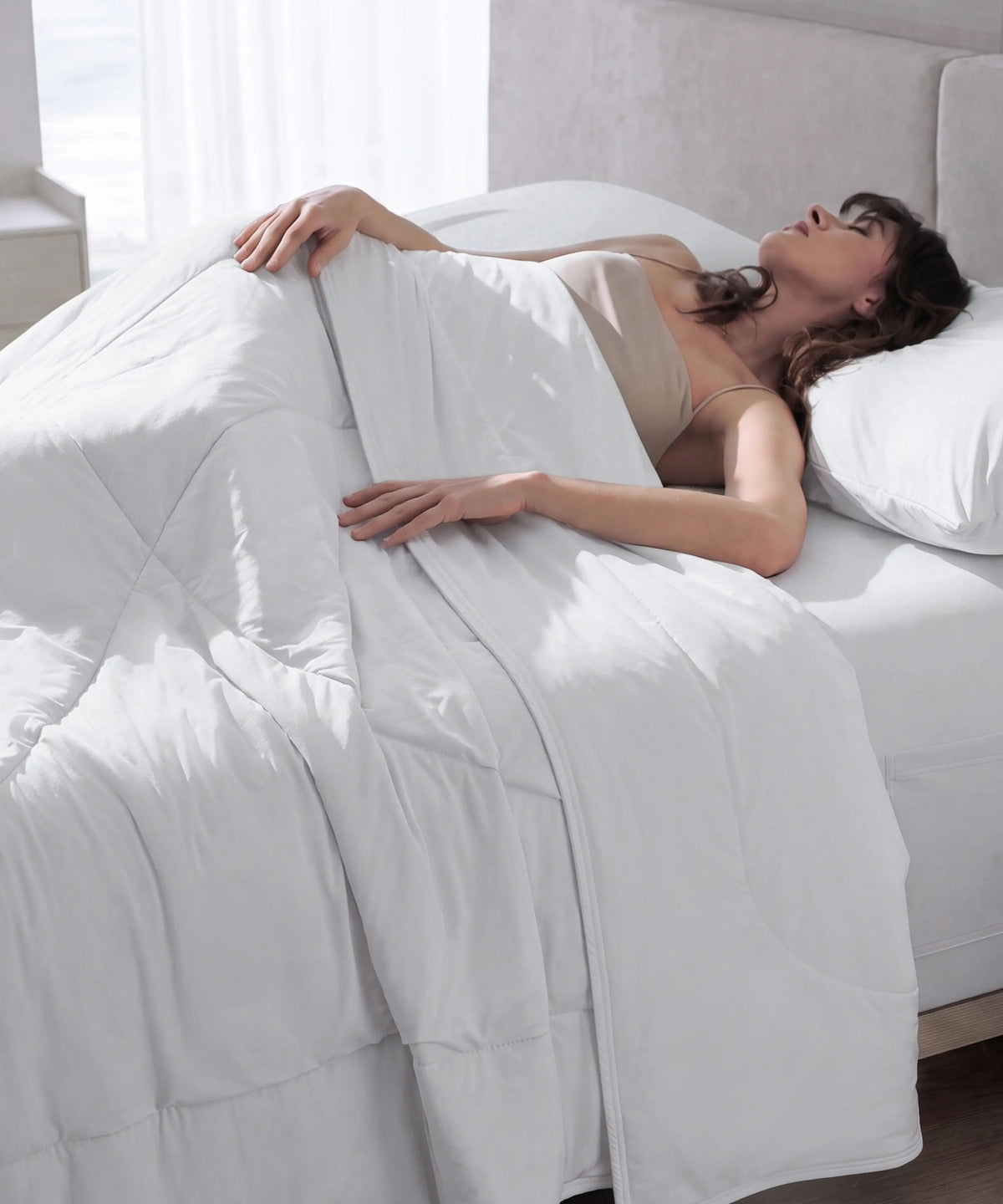
BlendTek™ fibers are ultra-fine — 6x finer than silk by fiber diameter[1] — which produces a lightweight, smooth sheet that maintains structural integrity. The Breescape Cooling Sheet Set flat sheet is 108" x 106", which is up to 15.3% more coverage than standard sizing[1] — relevant for sleepers who move at night and risk pulling the sheet loose.
Five Questions to Answer Before Buying for a Humid Climate
- What is the fabric's Qmax? (0.40 or above for a noticeable effect)
- Is moisture-wicking a structural property of the fiber, or a chemical surface treatment?
- What is the breathability rating relative to cotton? (4x or above is a meaningful gap)
- Does the flat sheet have enough coverage to stay in place when damp?
- Is the fabric certified safe for prolonged skin contact? (OEKO-TEX® Standard 100 is the relevant standard)
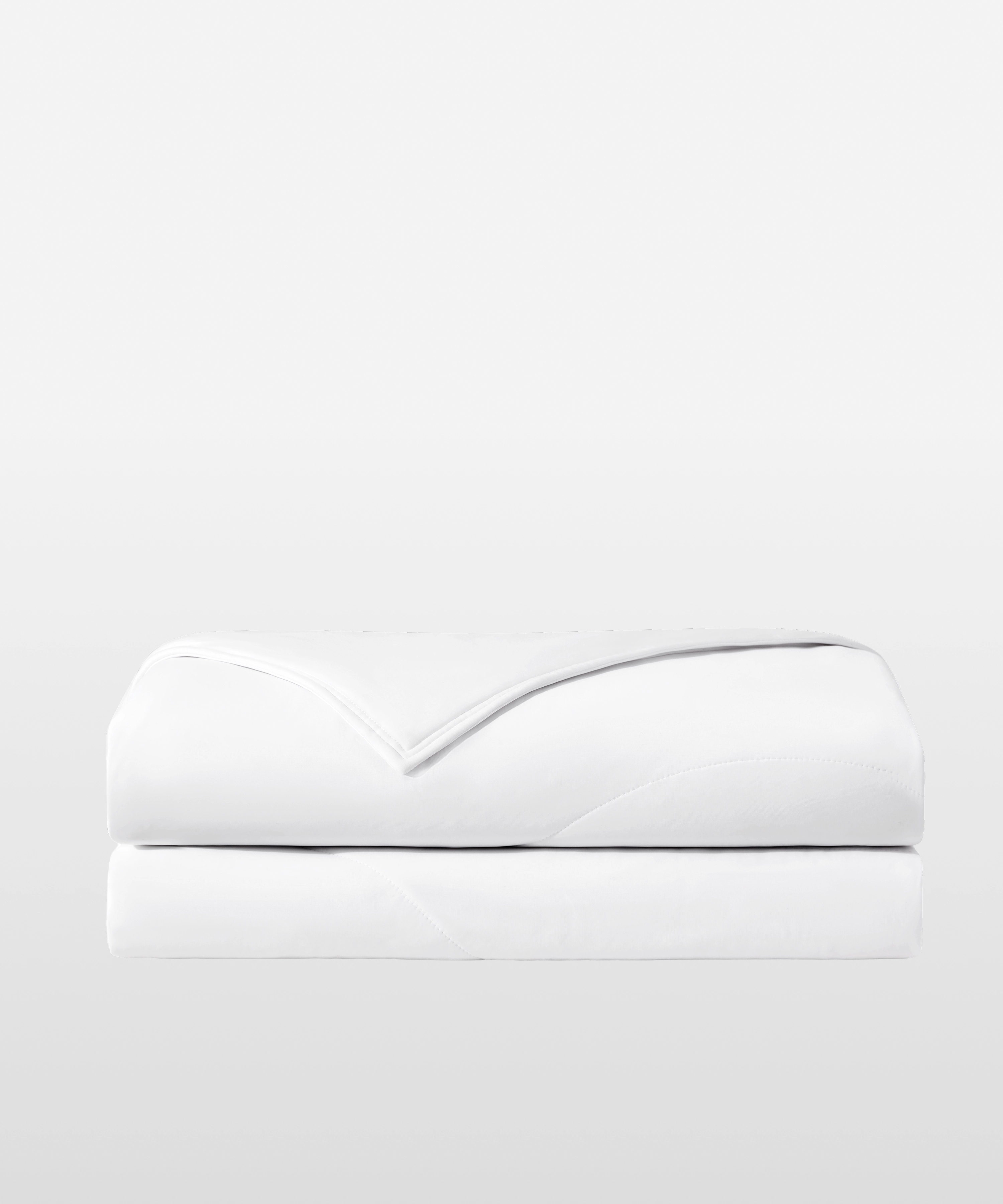
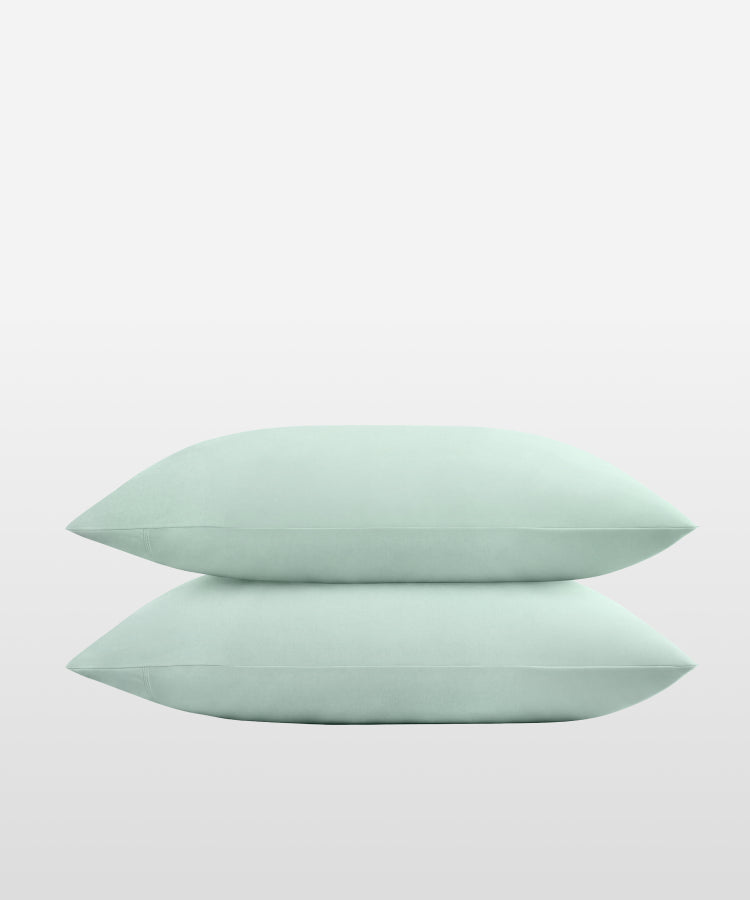
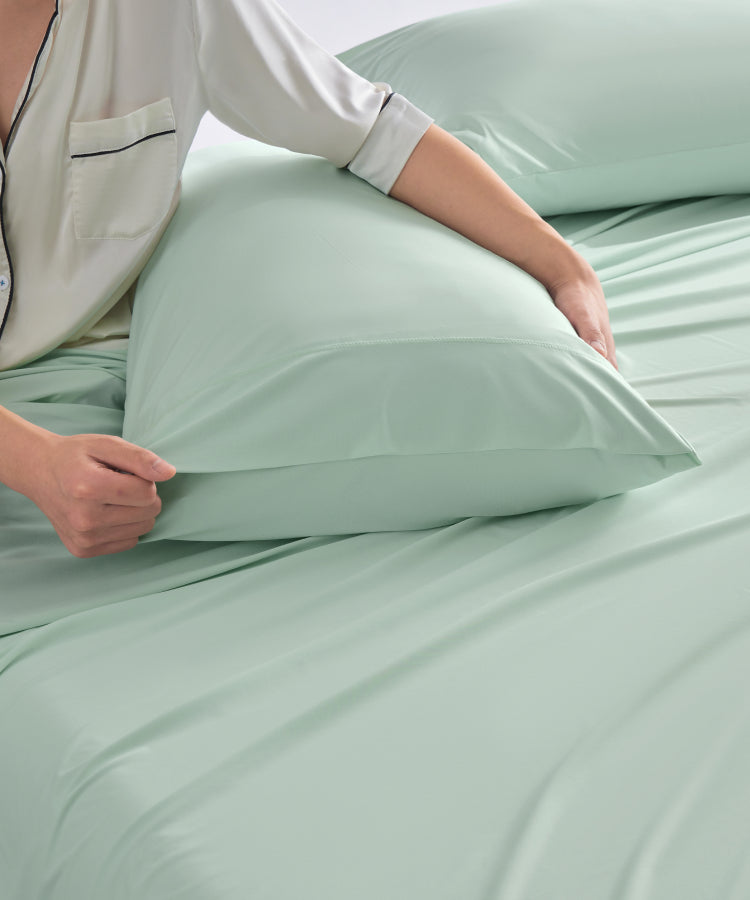
The Breescape Cooling Sheet Set 1.0 satisfies all five: Qmax above 0.46, structural fiber-based moisture management, 4.5x cotton breathability, oversized coverage, and OEKO-TEX® Standard 100 certification.[1] The Breescape Cooling Sheets 2.0 uses soft anti-slip grip strips to reduce flat-sheet shifting; its current official size guide lists 16-inch-deep fitted sheets.[5]
What Buyers in Warm, Humid Climates Actually Report
Current verified customer reviews provide useful context on cool touch, smoothness, moisture comfort, and fit, but individual results vary.[6] Homes & Gardens featured the Breescape Cooling Sheet Set in their spring sleep reset following real-use performance testing in March 2026.[7] The TODAY Show named it among their 100 Best Sleep Products the same month.[8]
Frequently Asked Questions
Q: Are cooling sheets actually different from regular sheets in humid conditions, or is the "cooling" label mostly marketing?
A: The difference is measurable when the cooling properties are structural rather than a surface treatment. Fabrics with high Qmax and open fiber structures that support moisture evaporation perform differently from standard cotton in humid conditions.
Q: My bedroom is humid but not especially hot. Do I still need cooling sheets?
A: High humidity interferes with the body's evaporative cooling system even at moderate temperatures. Moisture-wicking sheets reduce the damp sensation and improve sleep comfort in humid rooms regardless of ambient temperature.
Q: What Qmax should I look for in sheets specifically for humid climates?
A: 0.40 or above for a noticeable cool-touch effect. Breescape BlendTek™ measures 0.46; standard cotton is approximately 0.16; bamboo rayon is approximately 0.15.
Q: Does the moisture-wicking performance hold up through regular washing?
A: Yes. BlendTek™'s wicking properties are structural — built into the fiber geometry, not applied as a coating. They are not degraded by regular machine washing in cold water with a gentle cycle.
Q: Do I need a deep-pocket fitted sheet if I also use a cooling mattress topper?
A: Likely yes. A mattress topper typically adds 2 to 4 inches to mattress height. Current official size guides list 16-inch-deep fitted sheets; Classic 1.0 uses all-around elastic, while 2.0 adds grip strips to help the flat sheet stay in place.
Q: Are BlendTek™ sheets safe for people with skin conditions worsened by humidity?
A: The sheets are OEKO-TEX® Standard 100 certified (SH025 238997), confirming they are free of harmful substances. BlendTek™ fibers are 6x finer than silk, creating a smooth, low-friction surface that reduces mechanical irritation during sleep.
References
[1] Breescape Cooling Sheet Set — BlendTek™ specifications. https://breescape.com/products/cooling-sheet-set
[2] Sleep Foundation. "How Temperature Affects Sleep." https://www.sleepfoundation.org/bedroom-environment/temperature
[3] National Institute for Occupational Safety and Health. "Heat Stress." https://www.cdc.gov/niosh/topics/heatstress/
[4] Sleep Foundation. "Best Temperature for Sleep." https://www.sleepfoundation.org/bedroom-environment/best-temperature-for-sleep
[5] Breescape Cooling Sheets 2.0 — anti-slip grip strips, dimensions, and care. https://breescape.com/products/antislip-cooling-sheet-set
[6] Breescape verified customer reviews. https://breescape.com/pages/reviews
[7] Homes & Gardens. "The Spring Sleep Reset." March 2026. https://www.homesandgardens.com/sleep/spring-sleep-reset
[8] TODAY Show. "100 Best Sleep Products." March 2026. https://www.today.com/shop/100-best-sleep-products-rcna262950