
Cooling Bedding for Couples with Different Sleep Temperatures: A Practical Setup Guide
One of you sleeps with the fan on full blast and a single sheet. The other reaches for a second blanket at midnight. If this describes your bed, you're not alone: couples often need different sleep conditions, and temperature is one of the most common reasons shared beds become harder than they should be.[1]
The good news is that shared-bed temperature conflict is a solvable problem — but most popular solutions either address only one partner's comfort or require expensive equipment. This guide explains why the problem exists, what actually works, and how to build a bedding setup that genuinely functions for both of you.
| Factor | Effect on Sleep Temperature |
| Biological sex | Men typically generate more body heat due to higher muscle mass; women experience more variable temperature due to hormonal cycles (menstrual, perimenopause, postpartum) |
| Metabolic rate | Higher metabolism = more heat production at rest; varies significantly between individuals |
| Age | Older adults have reduced ability to regulate sleep temperature; perimenopause causes episodic overheating |
| Sleep position | Stomach and side sleepers trap more body heat under the torso |
| Body composition | Higher muscle mass generates more heat; higher body fat is more insulating |
These differences reflect genuine physiological variation, not just preference. A solution that requires one partner to simply "put up with" their temperature discomfort isn't sustainable and tends to accumulate into resentment, separate sleeping, or chronic sleep deprivation.[1]
Why Most Common Solutions Fall Short
- Thermostat compromise: A middle temperature satisfies neither partner. The hot sleeper is still too warm; the cold sleeper piles on extra blankets, creating the exact heat trap the hot sleeper needs to avoid.
- Separate blankets: Better than shared, but doesn't solve the problem if the shared fitted sheet has poor breathability. Many couples find separate blankets awkward aesthetically and for intimacy.
- Dual-zone electric mattress pads: Effective but expensive ($500–$2,000+), require setup, and add monthly electricity costs.
- Regular cotton or down bedding: Cotton traps moisture once damp; down fills trap warmth regardless. Neither was designed for temperature differentials.

The Two-Layer Approach: What Actually Works
The most practical approach separates the problem into two layers: the shared surface layer (the fitted sheet, which both partners always contact) and the cover layer (the comforter or blanket, which can be managed individually).
Layer 1: The Shared Sheet — Critical for Both Sleepers
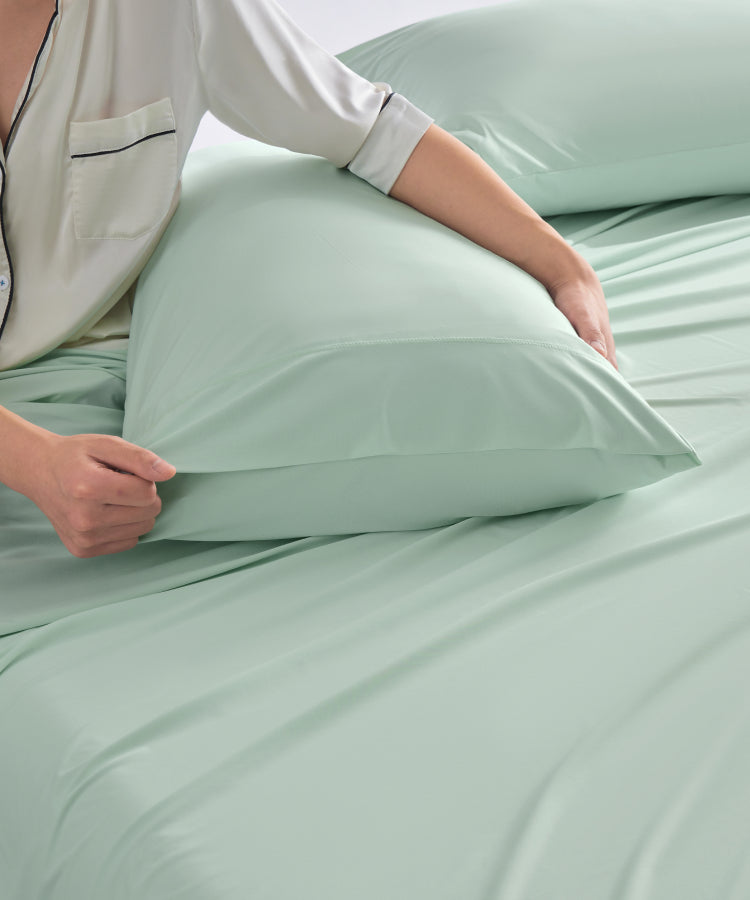
The fitted sheet is non-negotiable shared territory. If the sheet traps heat and moisture, both sleepers suffer — particularly the hot sleeper, who is generating more heat and sweating more. The sheet needs to work for the hot sleeper without making the environment too cold for their partner.
A cooling sheet with high breathability and effective moisture-wicking keeps the hot sleeper from overheating by moving heat and moisture away from their body, while ambient room temperature provides sufficient warmth for the cold sleeper. It does not refrigerate the bed — it prevents the hot microclimate from spreading.
Breescape's Cooling Sheet Set uses BlendTek™ fabric with a verified Q-Max of ≥ 0.46 — more than twice standard cotton — and 4.5× greater breathability. The deep-pocket fitted sheet fits mattresses up to 18 inches with a 360° elastic band for secure fit through the night. The flat sheet offers 15.3% more coverage than standard sizing for better full-body drape.[3]
Layer 2: The Comforter — Adaptability Over One-Size-Fits-Both
For the cover layer, the goal is a comforter that gives the hot sleeper active thermal management while still providing enough warmth for the cold sleeper. A reversible dual-sided design addresses this: one side provides instant cool-touch feel for the hot sleeper; the other promotes airflow for a warmer-but-breathable experience.
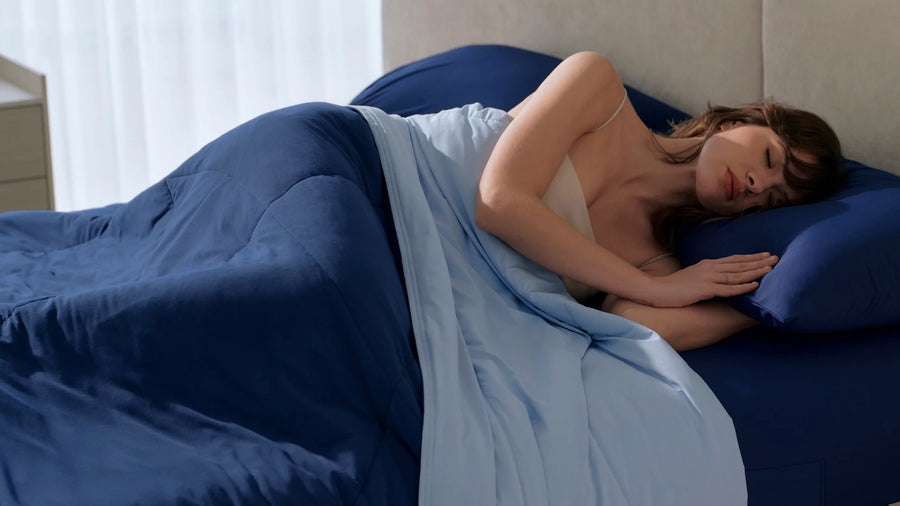
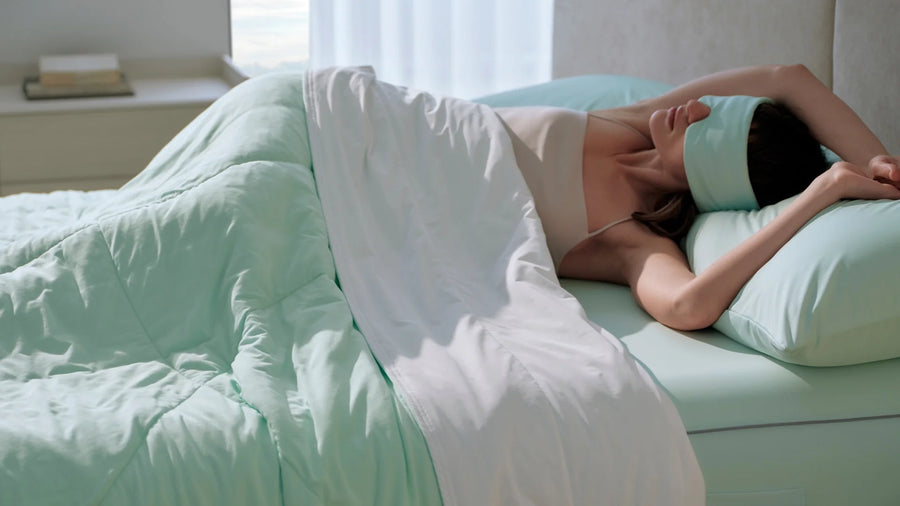
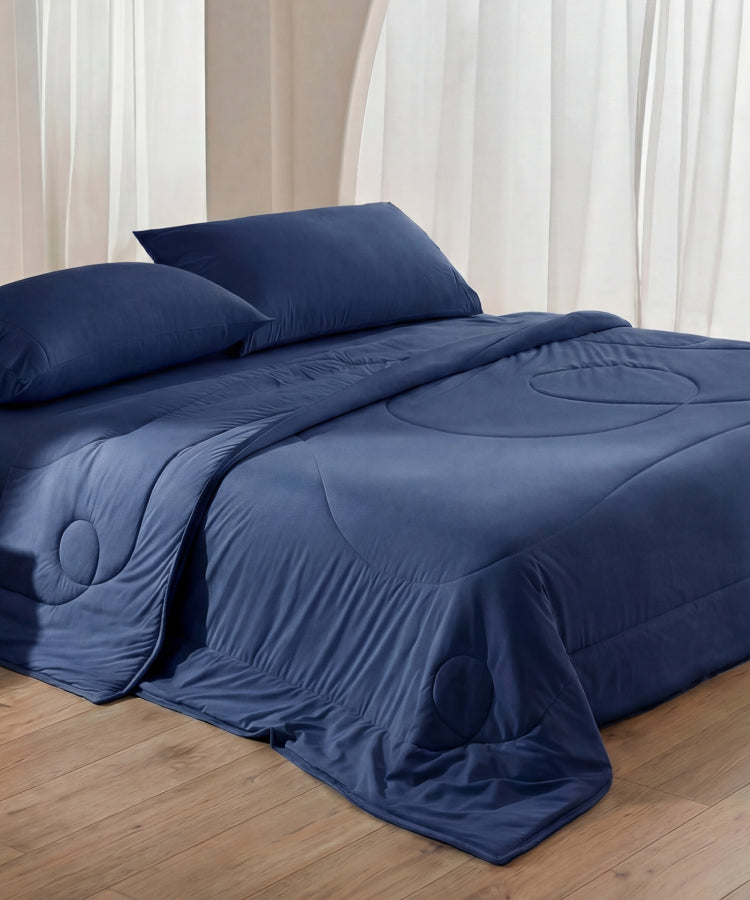
Breescape's Cooling Comforter is reversible: the cool side uses BlendTek™ fabric with Q-Max 0.46 for immediate temperature draw-down; the breathable side uses a 58% Eco-Cosy® Viscose / 42% Nylon blend that allows airflow without the instant-cold sensation. Partners can position the comforter so each side faces the appropriate sleeper, or choose which side to sleep under based on their temperature needs on any given night.[4]
The comforter is designed to be used without a duvet cover. For couples, this is important: a cotton duvet cover insulates the BlendTek™ surface, reducing the hot sleeper's cooling significantly while adding minimal warmth for the cold sleeper.
The Comforter Set: A Complete Coordinated System
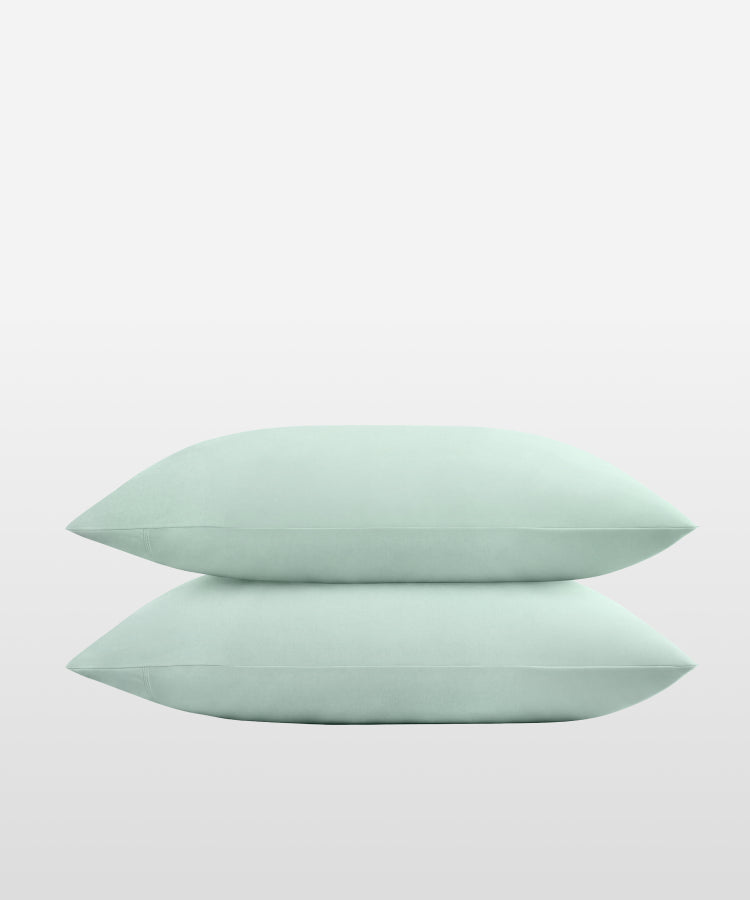
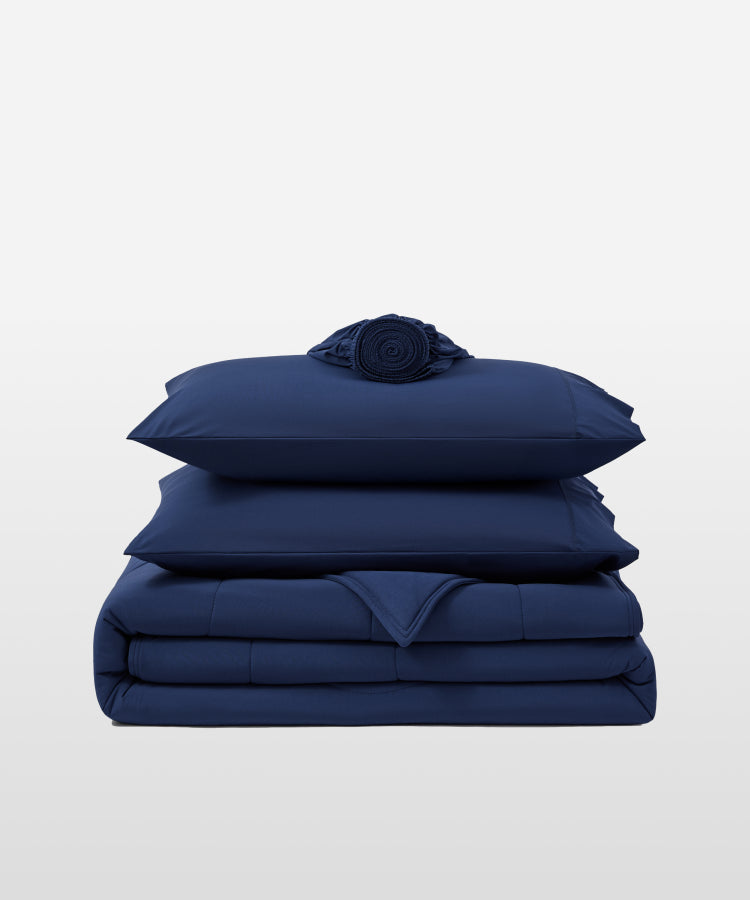
For couples starting from scratch, the Breescape Cooling Comforter Set — which includes the cooling comforter, a fitted sheet, and two pillowcases — provides the full BlendTek™ system in a single purchase. All components use the same structural cooling fabric, which means both sleepers are in contact with breathable, moisture-wicking material across every point of contact.[4]

Practical Setup: Recommended Configurations by Scenario
| Scenario | Recommended Setup |
| Moderate difference (one partner slightly warmer) | Shared cooling sheet set + shared cooling comforter (cool side facing the warmer sleeper) |
| Significant difference (one partner consistently overheating) | Shared cooling sheet set + individual lightweight throw for the cold sleeper over the shared cooling comforter |
| Hot sleeper + cold sleeper, king bed | Shared cooling sheet set (king size, 18" deep pocket) + each partner's own comforter or throw — eliminates blanket-fighting entirely |
| Hot sleeper during menopause/perimenopause | Shared cooling sheet set + cooling comforter used directly (no duvet cover) + cooling pillowcases for the hot sleeper |
The most common mistake couples make is treating the temperature problem as a single-product problem. A cooling comforter alone won't help much if the sheet underneath is trapping heat. The sheet is the foundation.

Should You Add a Cooling Mattress Topper?
For couples where the hot sleeper's overheating is severe enough to radiate heat across the shared mattress, a cooling mattress topper adds another layer of thermal management. Breescape's Cooling Mattress Topper features a high-perforation foam core with a breathable air-layer surface (Q-Max > 0.4), 360° breathable mesh sides, and a removable washable cover.[5]
The topper sits below the fitted sheet, creating a cooler mattress surface for both sleepers. Combined with cooling sheets and a cooling comforter, this three-layer approach creates a thermally neutral sleep environment — one in which neither partner is fighting the bedding to maintain comfort.
Keeping the Setup Stable Through the Night
For couples with different sleep patterns, stability matters: if one partner moves more, bedding can shift toward the middle or slide off one side. Breescape's Cooling Sheet Set uses a 360° elastic band on the fitted sheet for a secure fit on mattresses up to 18 inches deep.[3] For the comforter, tucking the foot end under the mattress is a practical solution that works especially well on king-size beds, where the comforter has more fabric to anchor.
Frequently Asked Questions
Q: My husband runs hot but I always feel cold — what's the best bedding setup for us?
A: Start with a shared cooling sheet set. A high-breathability, moisture-wicking sheet keeps the hot sleeper from overheating without making the bed cold for you. Then consider a reversible cooling comforter: the hot sleeper uses the cool-touch side, the cold sleeper uses the breathable side. This is more effective than a thermostat compromise.
Q: Can both partners share a cooling comforter, or does the cold sleeper end up too cold?
A: A good cooling comforter is not the same as a refrigerating blanket. BlendTek™ fabric moves heat away from the hot sleeper's body without producing active cold for the other side. The cold sleeper can add a thin throw on top if needed. The reversible design gives both partners options.
Q: What comforter size works best for couples who share a bed?
A: Breescape's king and queen comforters are oversized compared to standard dimensions — offering up to 13.8% more coverage. This extra coverage reduces blanket tug-of-war. King is recommended for king beds to ensure full coverage for both sleepers.
Q: Does a cooling comforter work year-round for a couple with different temperature needs?
A: Yes. The reversible design allows seasonal adaptation: in summer, both partners can use the cool-touch side; in winter, the cold sleeper uses the breathable side while the hot sleeper uses the cool side. Do not add a cotton duvet cover over the BlendTek™ surface, as this significantly reduces the hot sleeper's cooling.
Q: We have a king mattress — which sheet sizes should we order?
A: Breescape's Cooling Sheet Set is available in King size, with a fitted sheet accommodating mattresses up to 18 inches deep. The flat sheet is oversized (108" × 106") for additional drape and coverage for both sleepers.
References
[1] Sleep Foundation — Sleep Divorce vs. Sharing a Bed: https://www.sleepfoundation.org/sleep-news/sleep-divorce-versus-sharing-a-bed
[2] National Sleep Foundation — Best Temperature for Sleep: https://www.sleepfoundation.org/bedroom-environment/best-temperature-for-sleep
[3] Breescape — Cooling Sheet Set (product specs, sizing, elastic band): https://breescape.com/products/cooling-sheet-set
[4] Breescape — Cooling Comforter Set (product specs, reversible design): https://breescape.com/products/cooling-comforter-set
[5] Breescape — Cooling Mattress Topper: https://breescape.com/products/cooling-mattress-topper
[6] Breescape — FAQs (BlendTek technology, duvet cover guidance, year-round use): https://breescape.com/pages/faqs
[7] Real Simple — Best Lightweight Cooling Comforters (Breescape reviewed): https://www.realsimple.com/home-organizing/decorating/decorating-bedroom/best-lightweight-cooling-comforters
[8] Breescape — How Couples Can Avoid a Sleep Divorce: https://breescape.com/blogs/blogs/cooling-comforter-sleep-divorce
[9] Breescape — How the Structure of a Cooling Comforter Benefits Couples: https://breescape.com/blogs/blogs/cooling-comforter-for-couples